
Stormwater fees
We help organise the issue of stormwater charges in a way that delivers real savings for cities.
We specialise in implementing stormwater charges levied on residents and in optimising the fees paid to Polish Waters for stormwater discharge and lost retention.
We support cities in auditing stormwater charges and in building and implementing charge calculation models. We analyse data, verify assumptions, prepare financial simulations, and help implement organisational and digital solutions, including the GIShub application, which supports the management of charges and water and wastewater infrastructure assets.
Managing Stormwater Charges
GIShub is an infrastructure management system operating in a GIS environment, equipped with a Fees module that supports the automation of settlements related to stormwater. This includes the calculation of charges for lost retention, operating fees charged to residents, and payments transferred to Polish Waters.
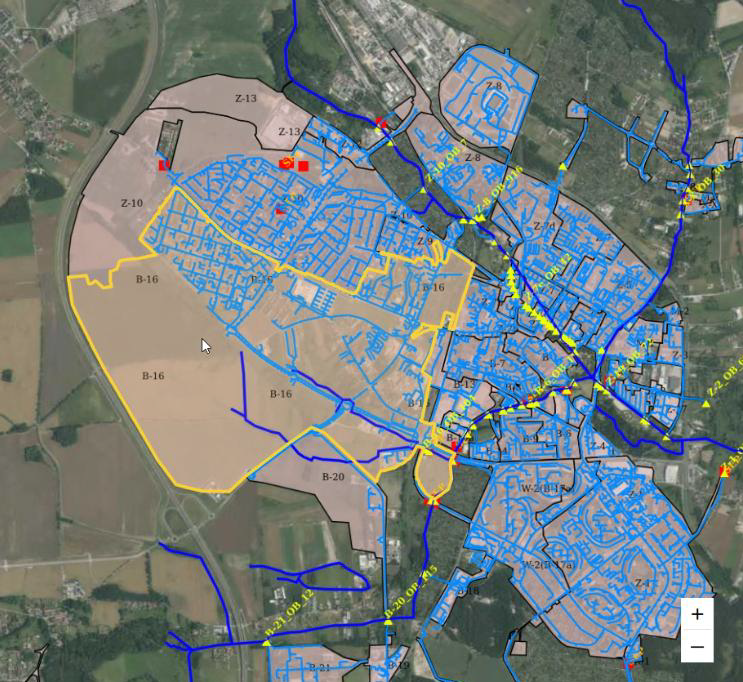
To calculate charges correctly, the platform uses descriptive data relating to plots, properties, and catchments, supplemented by geospatial information, including administrative divisions and the degree of surface sealing. The system allows users to configure rates, apply discounts, and define exemptions from charges. Settlement results can be presented in the form of tabular summaries for individual categories, as well as reports tailored to the user’s needs. GIShub also offers a letter generator based on templates prepared by the operator, which can be sent directly to Polish Waters. In addition, the system archives the history of charges, making it easier to analyse and monitor data over time.
The tool allows both the import and export of attribute and geospatial data. It can also be integrated with other systems used by the client, as well as rainfall data from rain gauges and the RainBrain application, which streamlines implementation and shortens the time needed to launch the solution within an organisation, while also facilitating settlements with Polish Waters. GIShub was designed primarily for small and medium-sized entities, in particular water utilities and organisations responsible for the operation of water and wastewater networks.
Discover the GIShub application
GIShub functions
- building and maintaining databases for plots, properties, and catchments,
- automatic calculation of charges for reduced natural land retention, together with generation of correspondence,
- handling settlements with Polish Waters and operating fees charged to residents,
- the ability to define surface sealing levels and different tariff groups,
- creation of a consistent register of plots, buildings, and impervious surfaces,
- presentation of catchments and plots on a map with the ability to update data on an ongoing basis,
- preparation of reports and analyses tailored to the user’s needs.
GIShub training
The new Water Law imposes an obligation on municipalities to implement a system for determining and collecting charges for reduced natural land retention. Thanks to our audits, cities achieve real benefits resulting from the correct and optimised calculation of stormwater discharge charges. It is worth noting that the Water Law does not specify the method for calculating the variable charge, and its correct calculation is the responsibility of the payer.

The optimisation of stormwater charges in Lubin delivered savings of 40% for the city — read more.
The city gains
- reduced risk of overcalculation,
- a more structured process,
- time savings in quarterly settlements and system operation,
- compliance with the requirements of the new Water Law regarding the implementation of a system for determining and collecting charges for reduced natural land retention.

Check whether your charging model has been calculated correctly and whether it can be improved. Our company’s expert in this field is Jacek.
Get in touch with us and fill in the form.


FAQ
How are stormwater charges calculated?
This requires accurate data on sealed surfaces, a transparent methodology—preferably based on rain gauge data—and knowledge of both the drainage system and the applicable rules for settlements under the Water Law and other regulations.
Can a stormwater charge audit reduce a city’s costs?
Yes. An audit often reveals errors in the data, assumptions, or charging process and can therefore reduce the risk of overpayments or incorrect settlements. In many cities, overly conservative calculation methods are still used, unnecessarily overstating the discharged water volume. Only the use of local rain gauge measurements makes it possible to make the charges clearly more realistic.
Does implementing a system of charges for reduced natural retention require GIS data?
Usually yes, because without coherent spatial data it is difficult to build a transparent charging system.